Pages

Powered By Blogger

Sunday, June 16, 2013

No. 32: Do not compete on price; what matters most is what products are available for 100 yen (June 17, 2013)

Marketing:
Customers get excited with low prices, but being cheap alone cannot keep them attracting forever. The 100-yen shop is widespread across the country because the strategy to sell every product for 100 yen hit a jackpot. The leading four 100-yen shop chains have 5,500 shops today and achieved combined sales of about 550 billion yen in 2012. They have increased the number of shops at nearly 20% per year during the past five years. One of the best selling products of the 100-yen shops is dry battery. Daiso, the market leader, sells about 150 million dry batteries per year, about six times more dry batteries sold by a leading convenience store chain. In a sense, dry battery is the product that symbolizes the 100-yen shop. As you sell more, you can get lower prices from manufacturers against a backdrop of the growing bargaining power, and subsequently the unit price will go down. This is an example of a virtuous cycle. However, the story is changing these days.

Seria that is the market follower is very energetic to develop new products in collaboration with manufacturers. They handle nearly 20,000 products, and introduce 500-600 new products per month constantly. Jointly-developed products accounted for 30-40% five years ago, but they account for nearly 90% now. Seria’s buyers go even to manufacturers’ plants in foreign countries to develop new products. Their efforts created such a noble products as cookware made of silicone, USB cable, and flashlight that uses LED. All of these products were unavailable for 100 yen in the past. Today, shoppers at 100-yen shops do not buy a product only because it is very cheap. That is, the industry has to cope with the decreasing impulse purchase. Consumers shop around and examine products by themselves, instead of stopping by at a 100-yen shop nearby to purchase a product only at a low price. Being cheap is no longer a strong merit of 100-yen shops. What matters most is what products they can make available at such a low price as 100 yen.

Today, you can find a very colorful lineup of manicure on the shelf of 100-yen shops. Do-Best supplies these manicure products to 100-yen shop chains. The company goes all the way to France to purchase the same materials used by famous French brands. Now you can purchase almost the same quality manicure sold 3,000 yen at a department store for only 100 yen at a 100-yen shop. The difference is the container and exterior package. The increased product competitiveness allowed some 100-shop chains to export their products to 15 countries including Korea and Myanmar.

The strengthened position of the 100-yen shop chains allowed them to be strict in the selection of location. For most commercial facilities, a 100-yen shop is vital to attract consumers. Seria, for example, declines a request for branching out from even a prime location. The company has established its own policy not to accept an offer unless it satisfies all their conditions, even though the offer comes from a prime location. The company examined about 300 locations and opened 60 shops in 2012. The company took away almost all the “100-yen shop” signs in its new shops to allow shoppers to enjoy shopping. The market leader Daiso also plans to change al the existing 2,700 shops to shops with posh atmosphere in five years. In addition, 100-yen shop chains are investing in logistics and an information system to prevent the out-of-stock condition.   

In the initial stage, low price is a strong weapon. Sooner or later, however, consumers get used to low prices. As manufacturers need innovations constantly, retailers need product development constantly. Offering services and products at a fixed price spread rapidly worldwide, as McDonald’s and Starbucks showed. But it is noteworthy that even these companies are exploring the way how to cultivate and develop the upmarket with upgraded products.   

The wonderful world of a 100-yen shop in Tokyo

Tuesday, June 11, 2013

No. 31: Focusing on promising business instead of pursuing the please-everyone policy (2/2) (June 11, 2013)

Management:
A company has to make the utmost efforts to develop its technology. Naturally, it is hard to keep creating innovations, but it harder to maintain the craftsmanship because every worker gets older and has to retire soon or later. Developing human resources who can inherit traditional craftsmanship is one of the big problems in heavy industries companies. As they fostered the diversification strategy, they decreased the number of recruits for the manufacturing scene. For example, the largest shipbuilding yard of Mitsubishi Heavy reduced the number of recruits starting in the mid-1970s. Accordingly, workers older than 50 accounted for over 60% in this shipbuilding yard in 2006, but they accounted for 25% in 2011. In exchange for the decreasing share of experienced workers, the share of workers younger than 20 increased to over 30%. It takes 10 years to develop human resources who can succeed craftsmanship of welding in the shipbuilding industry.

It is urgent for every Japanese shipbuilding companies to develop skilled workers in foreign countries to compete successfully with China and Korea. IHI is one step ahead of others, and it has developed more than 1,000 skilled workers in Vietnam and Indonesia. IHI enjoys a reputation of a company excel in developing skilled workers, and the good reputation worked very well to the company. A Brazilian shipbuilding company, Atlantico Sul Shipyard, changed its partner from Samsung Heavy to IHI. Negotiations on capital alliance are in progress between Atlantico Sul and IHI. In fact, Japan can be proud of its tradition to inherit craftsmanship from one generation to the next.

The shale gas revolution in the U.S. invited a worldwide attention and Japan will import shale gas from the U.S. In addition to shale gas, development of ocean resources will provide a tailwind to heavy industries companies. Ocean resources are expected to create a huge market for drilling ships and floating liquefied natural gas (FLNG) production facilities, and the market will increase about two times over the current level to 10 trillion yen by 2020. MODEC received an order from Malaysia for the design of a Malaysian FLNG last year. The total construction cost is estimated at 200 billion yen.

No company can be free from ups and downs in business, as the stock market. And most companies react nervously to the fluctuations, as most stockholders do. What is important for a company is to abandon unpromising business and focus on promising business, and the decision should be based on the technology including craftsmanship that it has accumulated. One of Japan’s leading consumer-electronics companies suffered from a huge loss as a result of its policy to please everyone. In the age of accelerating technological progress, no company can cover lots of business domains simultaneously however big it is. Develop technology and human resources that can inherit craftsmanship, while abandoning unpromising business fields. Unpromising business, in most cases, remains unpromising however hard you may try.  

A triangular ocean bed research vessel

Scientific deep sea drilling vessel (Chikyu: the Earth) 

Sunday, June 9, 2013

No. 30: Focusing on promising business instead of pursuing the please-everyone policy (1/2) (June 10, 2013)

Management:
Japanese three leading heavy industry companies – Mitsubishi Heavy, Kawasaki Heavy, and IHI – launched new products one after another for diversification to maintain domestic employment after the so-called depression on shipbuilding. They are sometimes dubbed the three machinery department stores. Because of the please-everyone policy, they were not able to make enough investments in promising markets and products, and they increased interest-bearing debt dramatically. Until quite recently, they recorded a 2-3% operating profit rate, less than half of Hyundai Heavy Industries of Korea.

Mitsubishi Heavy changed this stream. It started to reform its business structure and introduced the “strategic business evaluation system” in 2011. It integrated business operations and withdrew unprofitable business operations. As a result, it reduced the interest-bearing debt from 1,600 billion yen in 2009 to 970 billion yen in the current fiscal year, less than 1,000 billion year for the first time in the past 17 years. It will achieve sales of 190 billion yen, which is close to the highest sales in the past, and increase the operating profit to 6%.

The promising business field for them is the exploration of ocean resources where they can utilize their shipbuilding technology. The world ocean resources business field is expected to increase two times over the current level to more than 10 trillion yen by 2020, mainly thanks to the construction of drilling ships and offshore production facilities of liquefied natural gas. Mitsubishi Heavy delivered four resource exploration ships to Norway for about 100 billion yen. Its technology to minimize the engine noise and vibration was helpful for the successful order intake. 

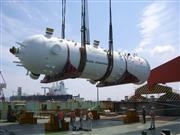
It is not too much to emphasize the importance of technology. Hitachi Zosen delivered its reactor vessel to Sasol of South Africa. A reactor vessel is the core equipment of the gas to liquid (GTL). It is 50 m tall, and it weights nearly 200 tons. Precise welding is indispensable to building a reactor vessel. Hitachi Zosen’s technology to bend and weld a hug thick steel plate will allow the company to keep growing. The company dubs itself a shipbuilding company on land. Stick to the technology that you have accumulated, and you can open up the road for further growth.

Hitachi Zosen's reactor vessel 

Sunday, May 19, 2013

No. 29: Publishing e-books and taking in people in general simultaneously is vital to spread Japanese culture (May 20, 2013)

Marketing:
Mickey Mouse is unquestionably the world’s most famous character, but Japan’s Hello Kitty is growing popular even in the U.S., the home country of Mickey Mouse. Sanrio, the creator of Kitty, reportedly renewed the highest operating profit in fiscal ended March 2013 and will supposedly renew it again in fiscal ending March 2014. Likewise, Japan’s two mobile game developers, DeNA and Gree, are growing very fast these days.

Cool Japan is a national policy to dispatch Japanese culture to the world. However, Japan has to overcome several headaches. One of them is unauthorized copies. In the world, underground websites get data on the latest issues of Japanese comics one week before they are sold at Japanese booksellers and put their unauthorized English versions on the Internet in just two days. That is, foreign readers read the latest contents free well before Japanese readers buy their favorite comics at a bookseller. Several Japanese publishers started to distribute e-books in alliance with foreign Internet companies, and publish a new issue simultaneously both at home and abroad. For example, an American venture, Crunchyroll, has been offering the charge system since 2009. The company has now 200,000 members who can read all comics at a flat rate of 6.55 dollars per month. As far as comics are concerned, the strategy to publish e-books and offer them to members all over the world simultaneously at a flat rate in alliance foreign Internet service companies has become vital.

The Japanese government is trying hard to keep foreign people informed of Japanese culture. Actually, Japanese contents successfully got fans called “Otaku (Fanatics)” worldwide. In fact, there are lots of people enchanted with Japanese culture, and it seems that the Japanese content industry is doing well in the export business. The fact remains that it exports only 5% of its total sales of 12 trillion yen. One of the reasons for the stagnant export value is the lack of efforts to increase fans. Japanese contents companies have been increasing fans with a focus on Otaku (fanatics). However, it is time to shift the focus from Otaku to non Otaku, who can be called people in general, to spread Japanese culture worldwide. Think about Nintendo’s strategy. Nintendo recorded a remarkable sales increase by taking in people uninterested in video games.  

The above story can apply not only to a country but also to a company. It is vital for every company to increase customers by strengthening its technology and service, responding to the change of market situation. In the case of the content industry, creativity matters most. Companies successful in trying to keep people excited with new contents will survive. As Peter Drucker taught us, “The purpose of business is to create and keep a customer.”  

 Is Japan cool?

Wednesday, May 8, 2013

No. 28: Convenience store chains in a turbulent age: IT and differentiation are the keys to survival (2/2) (May 9, 2013)

Management:
As leading chains focus more on locality, local chains are fighting back with their own strategies. There are about 2,700 convenience stores in Hokkaido that is the northernmost island, and a local chain by the name of Seicomart has 40% share there. The chain introduced the 100-yen prepared foods corner in 2009. They always sell about 50 kinds of 100-yen prepared foods and change menu seasonally to prevent customers from getting bored with the same menu. Every store of this chain has a kitchen inside, and customers shop around for 100-yen prepared foods, fresh foods, and drinks while they are waiting for their orders to be cooked. Seven-Eleven also offers 100-yen prepared foods, but it offers only 10 kinds. The game is over. The difference between 50 kinds and 10 kinds is too great.  

Self-efficiency supports prepared foods offered by Seicomart. As vegetables used for prepared foods are subject to market fluctuations, it is hard to maintain the price at 100 yen. This local chain procures 50% of vegetables from its own farms. It gets nearly 50% of its sales from private brands that range from 100-yen prepared foods to pickles and milk products. Trucks travel around the farms to pick vegetables and pickles after delivering commodities to each store. The logistics this chain built is working very well. This strategy helps it increase sales by 20% and operating profit by more than 70% in the past five years. As this chain shows, differentiation based on locality is important for survival.

As IT grows more important to business expansion, no chain is free from the pursuit of economies of scale. It is natural that some member stores affiliated with smaller chains are eager to increase sales by becoming a member of a larger chain. A convenience store in a rural area increased sales by 6.8% by changing the franchise to a larger nationwide chain. While the larger chain delivers commodities three times a day, the smaller chain decreased the frequency to two times a day. The store owner renewed his awareness of the comprehensive strength of the large chain. In fact, the brand strength of a larger chain is vital for convenience store owners. The difference of sales per store between Seven-Eleven and medium-sized chains increased from 140,000 yen in 2002 to 200,000 yen in 2012.

Accordingly, large chains open new stores in succession. Seven Eleven and Family Mart will open 1,500 new stores this year. Lawson, however, is taking a different approach, saying that being absorbed in opening new stores may impair the mind to develop innovative products and services. Lawson decreased the number of new stores to be opened this year 7% from the previous year to 870 stores this year. Lawson put more energy on making the existing network of chains more versatile. No one can tell which strategy will work well in the long run. As always, there is no correct answer in business. What is clear is that IT-supported efficiency and differentiation seem to be the two keys to survival.  

Super delicious fried chicken by Seicomart 
 

No. 27: Convenience store chains in a turbulent age: IT and differentiation are the keys to survival (1/2) (May 8, 2013)

Management:
There are more than 50,000 convenience stores at present, increasing from 44,500 stores to 50,000 stores in the past five years. Combined sales are 9,000 billion yen today. Leading chains now focus on local regions to expand business. Tokyo has one store for every 1,992 people, whereas Kagoshima Prefecture, southernmost prefecture, has one store for every 3,159 people.

Top five convenience store chains in Japan

Convenience store chain
No. of stores
in Japan
Domestic sales
(billion yen)
Seven-Eleven Japan
15,072
3,508
Lawson
11,130
1,906
Family Mart
9,481
1,715
Circle K Thanks
6,242
946
Ministop
2,168
352

With the accelerating aging of population, the access provided by a convenience store is growing more appealing to consumers. The boundary between supermarket and convenience store is growing more ambiguous. Many convenience stores are handling fresh foods and sell them in small packs for 100 yen apiece. The 100 yen groceries corner is growing more popular these days. It is no longer unusual that housewives and the elderly buy fresh foods with prepared foods in the evening. It is crucial for every chain to enclose customers. They key to the enclosure is IT and differentiation.

Lawson introduced Ponta that is a point card system usable at every Lawson store. One point is one yen, and shoppers can exchange their points for discount and designated products. Since the system was introduced, the assortment improved and shortage of popular products decreased dramatically. Enchanted by the effect of Ponta, stores are very eager to obtain new members. This good cycle helped Lawson increase sales greatly.

Seven-Eleven is taking another strategy. It sells fresh coffee nationwide. The prefecture that sells most is Kagoshima Prefecture. A Seven-Eleven store in this prefecture sells 280 cups of fresh coffee a day, and sales increase to 360 cups on the weekend. Seven-Eleven spends two months to educate employees for new stores, and they are competent enough to tell the difference in taste between generally available coffee and Seven-Eleven’s fresh coffee. Family Mart is also carrying out a new strategy. It concluded a franchise agreement with two organizations affiliated with Japan Agricultural Cooperatives. They also started mobile catering of vegetables. A new system is required to sell consumers in a scarcely populated area.  

 
Introduction of Japanese convenience stores
 

Monday, April 29, 2013

No. 26: The importance of pursing the strongly established business domain to compete in the global market (April 30, 2013)

Management:
Suntory is very active in expanding the Southeast Asian market. The company currently has sales of several tens of billion yen in this market and plans to increase the sales to 100 billion yen in three years. Focusing on the Southeast Asian market is part of Suntory’s strategy to become a global company in the true sense of the word. The target company is Nestle of Switzerland. It is a long way to catch up with Nestle. Nestle has sales of 9,300 billion yen, while Suntory’s sales are 1,850 billion yen.   

Suntory grew rapidly by expanding the whisky business around 1930 by taking advantage of the westernization of Japanese dietary life. Actually, whisky characterized the company for a long period. In the 1980s and 1990s, its whisky business dwindled because it failed to understand the change of consumer behavior precisely. Realizing that youths do not drink hard drinks as much as their parents did, the company reorganized the business portfolio drastically and set the soft drinks business as the mainstay. Soft drinks increased the share in its business from 20% to more than 50% today. In fact, profit from soft drink sales accounts for 60% of its total profits. The company has established its business domain with the catch phrase “Suntory lives with water.” Its natural water sold about 6,400,000 cases, two times as many cases sold by the runner-up. In the soft drink market, Suntory has 22% share following the Coca-Cola group.

Suntory is also successful in the beer business. The company is now the third larger beer company, surpassing the Sapporo Beer. It has 16% share in the period between January and March 2013. Consumer behavior and taste change rapidly, and every company has making strenuous efforts to keep abreast of these changes. Even today’s bestselling products are destined to be one of the obsolete products sooner or later. The company will construct a laboratory staffed with 250 researchers in 2015. No company can maintain its competitive edge forever. Developing highly competitive new products needs a different approach free from the traditional way of thinking, the company reckons.  

Suntory’s traditional ad strategy in a new product launch is ad blitz with a decreased product price. The company spent about 450 billion yen on promotion and advertising in 2012. It spends about 24% of sales on promotion and advertising, as against competitors including Kirin spend between 11% and 15%. It is not too much to say that future of a company depends on new product launch. Suntory’s famous company attitude – Go for it – will help the company continue growing.    

Suntory’s canned coffee CMs starring Tommy Lee Jones